
How To Crate Train Your Dog
Tried and True Tips and Tricks for Kennel Training a Dog or Puppy
Crate training is more than simply putting your dog in their kennel and hoping for the best. When approached thoughtfully, the ability to crate or confine your dog can be one of the most useful tools you have available to you. If you’re not sure how to get started crate training your dog, you’re in the right place. Our step by step instructions will help you get started on the right paw.
Why should you crate train your dog?
Provide Safety
Simply put, dogs often make choices that jeopardize their safety. Your dog does not inherently know that eating certain items can result in life threatening situations. Beyond that, it is easy for our dogs to find that one hazard in the house we would have never expected they’d find, when they’re left to their own devices or bored. Crate training or confinement training can help you keep your dog safe until you’re able to teach them the rules of living in the human domestic environment. Dogs have no concept of right or wrong, good or bad. They live in the moment. Some more than others. That being said, you may choose to utilize the crate or some form of confinement life long, in certain contexts, and that’s perfectly fine.
Behavior Management
What gets practiced, gets repeated. Yep. The more your dog counter surfs and finds amazing items to eat or destroy, the better they will get at counter surfing and the more motivated they will be to look for opportunities to counter surf. So if you’re finding that a particular behavior is happening repeatedly, and you want to get ahead of it, consider crating or limiting your dog’s access to the environment as needed through the use of baby gates or an exercise pen.
Travel
Dogs don’t generalize well. Which means that even if your dog is well behaved at home, when we take them to new places, like a family member’s home or a hotel, they can struggle to understand that the rules they learned at home apply to the new locations, too. The more you reinforce “good choices” and manage their environment (using confinement as needed) to prevent choices us humans don’t like from occurring, your dog’s success in novel environments is more likely to increase. If you simply give your dog full reign of a new space, don’t be surprised if they stick their head into every crevice they can, or even if they struggle to signal that they need to go to the bathroom!
Encourage Independence
Many of our dogs struggle to be alone. Dogs are social animals, so their desire to spend time with another being they are bonded to is to be expected. That being said, when you’re first teaching your dog how to be alone, the kennel, when introduced properly, can be a safe place for your dog to rest and spend time away from you.
Important
It is a myth that dogs are den animals. It is also a myth that crate training will “fix” separation anxiety. For many dogs that have separation anxiety, being confined to a small space compounds the stress and panic they experience when alone. If you’re concerned your dog has separation anxiety, reach out to a qualified separation anxiety focused dog trainer. Meaghan at Dog Flower offers virtual private lessons to clients nationwide, and would be happy to help you determine if your dog has separation anxiety, and as a Certified Separation Anxiety Profession - Behavior Consultant, is qualified to help you help your dog feel more relaxed when alone.
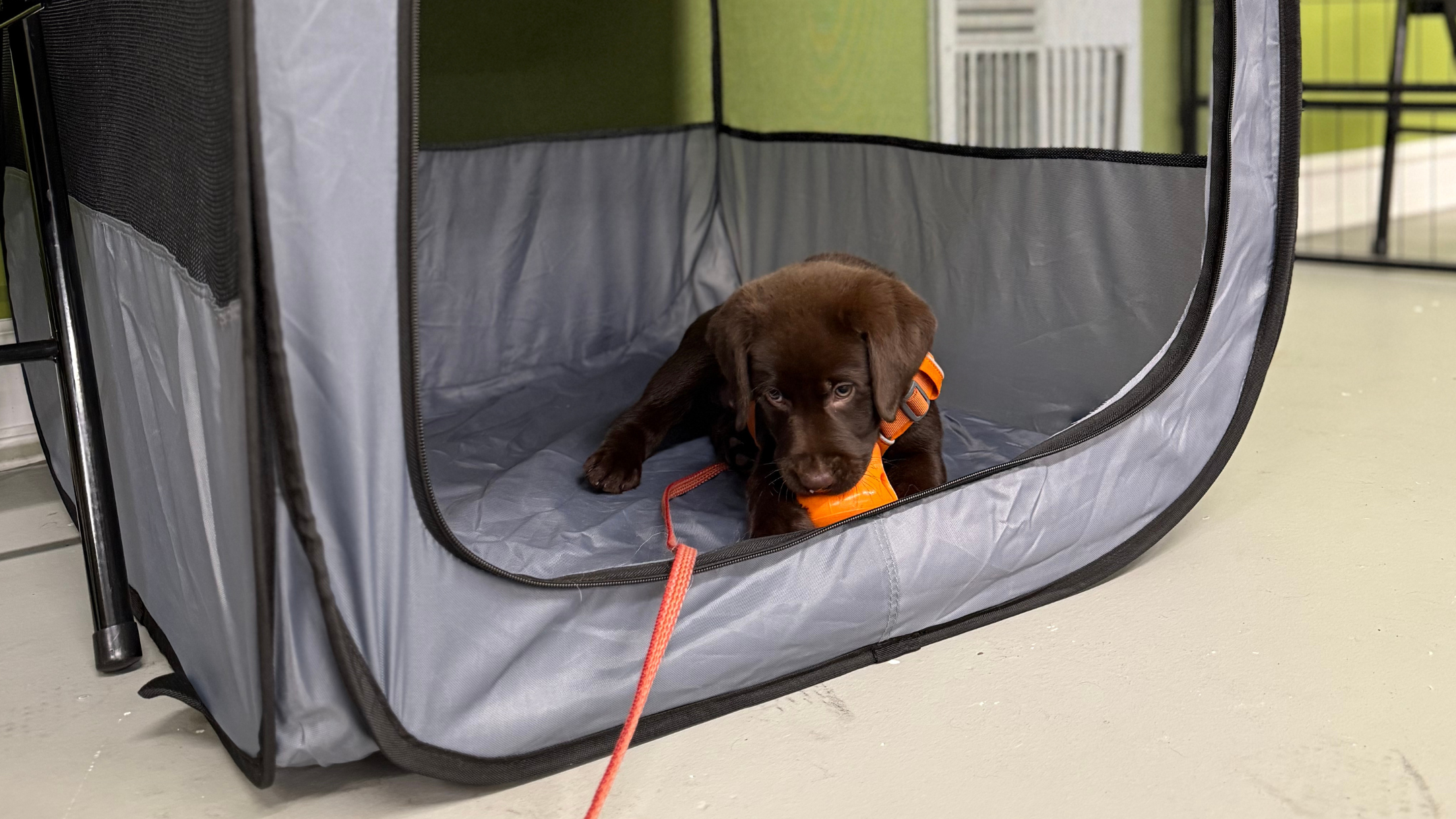
A chocolate Labrador puppy named Odo is laying down in a pop up dog crate. He is licking frozen chicken from a Toppl toy during a break at his first Puppy Social session.
How do I crate train my dog?
Choosing appropriate Confinement Options
If I’m crate training a puppy or young dog, I usually like to have two crates. One in my bedroom and one in a more lived in area of the house. I try to have the crate that is in the more lived in area of the house connected to one or two exercise pens so I can have a large area that my dog has access to, without giving them full access to my home. Be sure that the crate you choose is large enough for your puppy to stand up, turn around, and sprawl out a bit in. Think of your crate as a shorter term confinement option in the beginning or for sleeping overnight, and the bigger area as a place your young puppy can hang out in while they’re working through potty training. The larger area can also help to ensure you’re not crating your puppy too long right out of the gate, especially when they’re still getting used to it! Fill the larger confinement area with toys that your puppy can be left unsupervised with, a water bowl, and puppy safe bedding (cots are nice).
Building Positive Associations
We want the crate to be a place that your puppy is comfortable walking into on their own, and that they feel positively about spending time in. To make sure that is what happens, work on crate training incrementally. Build multiple short crating periods throughout the day into your routine. Avoid using the crate as punishment. It is okay to use the crate to manage your dog’s behavior or to give them a break, if your dog already feels comfortable with going into the crate. If they don’t yet feel comfortable in the crate, consider using a larger break area such as the exercise pen or gating off a dog-proofed room in your house.
Crate Games
I like to play a game of “In & Out” with dogs when we first start crate training. While playing this game, I focus on building comfort with dogs walking into the crate through tossing treats into the crate, then tossing a treat away from the crate, repeating until the dog can follow a treat all the way into the crate. When they can do that, I will start to dispense a few treats at a time while they’re hanging out in the crate before tossing a treat to encourage them out of the crate. Eventually, I add a cue such as “Kennel Up” and add in closing the door to exercise. This will likely take multiple short training sessions. Work on something like this for a few minutes, a few times a day. Additionally, I like to play a game referred to as the Treat Fairy. The Treat Fair leaves really tasty treats in the crate so that your puppy is immediately reinforced for going into on their own. Lastly, I like to feed my dog’s meals in the crate, starting first with the door open and potentially me sitting with them, then gradually closing the door, and leaving the room while they eat their food.
Don’t Overdo It
If you crate your dog for longer periods of time than they’re comfortable with, it is common that a dog may refuse going into the crate, bark, whine, or even potty themselves in their kennel area. A pet monitoring camera such as the ones made by Pet Cube, can be a really helpful investment so that you can watch your dog in their confinement areas when you’re away. This will help you to determine how your pup is coping with confinement and alone time. If they’re struggling, you’ll know, and can adjust the routine accordingly.
Meet Your Dog’s Needs
If you do need to leave your dog in their confinement area, and especially if you’re leaving them alone for several hours or your entire work day, it’s of utmost importance that you meet their needs before leaving them. Make sure they’ve had the opportunity to eat, relieve themselves, and provide them with physical and mental stimulation prior to kennel time. If your dog needs to be kenneled for more than a few hours, I strongly recommend having a dog walker or a friend come by once or twice during the time that your dog will be alone or in their confinement area to take them out for some exercise and interaction.
HOW CAN DOG FLOWER HELP?
Whether you need help with crate training, independence training, and separation anxiety training, we are here to help. Our private training services can help you help your dog feel better about spending time in confinement or alone. Learn more about our private training options HERE.
Not sure where to start? Scheduled a FREE 10-minute Discovery Call with Meaghan below.
LEARN MORE ABOUT THE AUTHOR, DOG TRAINER Meaghan SUMMERBELL
Meaghan Summerbell (KPA CTP, CSAP-BC, CTDI) is a multi-certified professional dog trainer serving East Portland, Gresham, Troutdale and Happy Valley, Oregon. Meaghan is dedicated to helping people understand the inner workings of canine behavior on a deeper, more meaningful level so you can become your dog’s best friend, too.
This is an AI free blog post. All blog posts are written and published by Meaghan.
Keywords: crate training, how to crate train, how to crate train a puppy, how to crate train my dog
