
How to Get Your Dog To Stop Jumping
polite greetings made simple
We all love a polite dog. The dog who walks up to you and stands there (or sits), waiting for some gentle petting. That being said, it’s much more common that a dog climbs up your body or launches themself at you. Maybe they even paw or nip at you while jumping. The common advice is just to ignore the jumping, the pawing, and the mouthing. You might have even had some success with ignoring. At the end of the day though, our dogs often end up confused when someone inevitably reinforces the jumping by paying attention to your dog. Instead of focusing on teaching your dog what not to do, I encourage you to focus on managing your dog’s ability to practice jumping on people, teach them what to do instead, and set them up for success by keeping greetings calm and short.
Teach your dog what to do instead of jumping
Dogs do what works to get their needs met. If your dog does not know of another way to get your attention besides jumping, then jumping is likely to be an ongoing issue. Remember that when we’re trying to teach our dogs an alternative or incompatible behavior, we are up against all the hundreds of repetitions where your dog was reinforced for jumping. Training will take time and consistency.
Sitting with duration. This is often one of the go-to behaviors because many people teach and reinforce sitting without even thinking about it! The issue I see arise is that many dogs are not taught to sit with duration. So as soon as they sit in front of a person and that person reaches to pet them, they immediately launch themselves up at that person. I encourage you to work on a sit with duration. Wait until your dog can sit for at least 10 seconds, then gradually add in petting and talking as distractions.
Stationing on a platform. I find that platforms such as a Klimb platform, a Cato board, raised cot, a bench or ottoman can all function well as a station for dogs. Encourage and heavily reinforce your dog for climbing on the platform. They can sit or stand. Build up duration to at least 10 seconds. From there, similar to with the sit, practice petting and talking to your dog.
Standing still with duration. Teach your dog to move from a “down” or a “sit” into a standing position. Once they understand the concept of “stand” you can being to reinforce duration, again working up to 10 seconds, at the least. From there you will add calm petting and talking as separate distractions.
Leaning into a person’s leg. Use a lure to get your dog standing at your side. Once they’re standing at your side, you can lure their head towards their shoulder. This should cause your dog to push their shoulder into your leg. The second you feel physical contact, mark “yes” and reward! Repeat this over and over. Once your dog is able to lean into your leg without the need for a food lure, you can begin to add in a second of petting and then reward. Gradually build up your ability to pet your dog. Then add in talking, rewarding your dog for standing still, leaning against your leg. If your dog chooses to sit and lean, that’s acceptable, too!
Laying down on a bed. Teach your dog to settle on a bed. Again, reinforce for duration until you have at least 10 seconds built up. From there, add brief moments of petting, and then build in your talking.
Go “say hi”. For this exercise, I like to send my dog to boop someone’s hand with their nose. I call that skill “touch”. Teach your dog “touch” independently, then practice with people in your household by telling your dog to “go say hi” and then having the helper person ask your dog for a “touch”. You will mark “yes” the second your dog touches their nose to the person’s hand, and encourage your dog to return to you for their treat. This is a great protocol for when our dogs are on a leash!
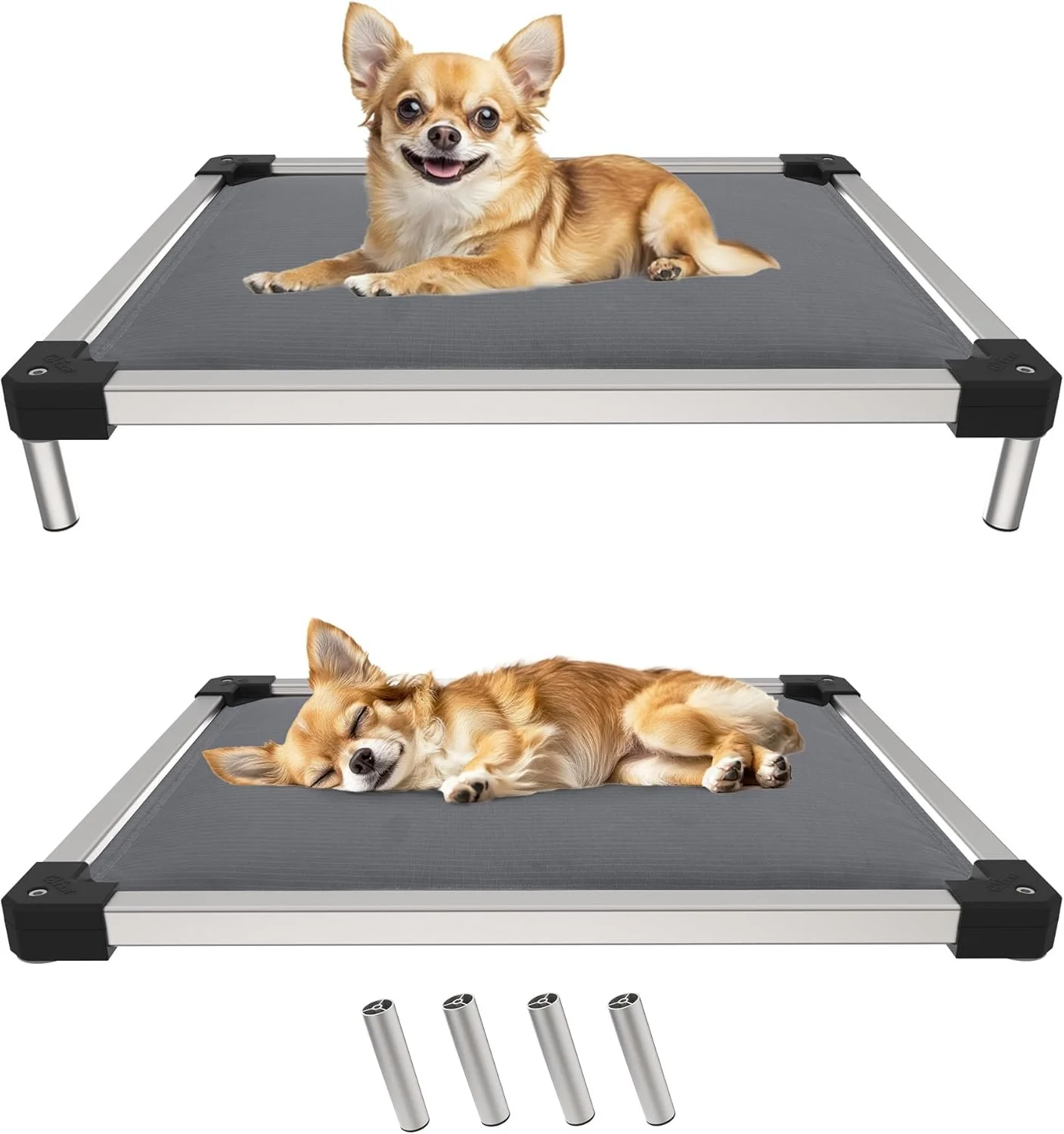
Chew Proof Dog Cot
Cots are great for teaching our dogs to station for polite greetings. I prefer chew-proof cots for young dogs.
Use management to Set your dog up for success
In addition to training taking consistently reinforcing incompatible or alternative behaviors to jumping, you will need to manage your dog’s environment to help prevent them from jumping on you and other people. When using confinement to manage your dog’s jumping behavior, its crucial that your dog is already comfortable in the confinement area. Be sure to practice putting your dog in the confinement area, reinforcing quiet and calm behavior, and giving them self-entertaining-systems (toys/treats) to make the confinement a comfortable experience. If your dog can’t be calm in a confined area without any guests arriving, it is unlikely they will be able to when a guest shows up!
Exercise pens. Make a bubble around the inside of your front door. This allows guests to enter without your dog rushing and jumping on them. They can get low and greet your dog closer to the ground. When your dog is more settled, the guests can come into the rest of the house. You can also put your dog in a penned off room or use the pen as an alternative to the crate. If you use the pen in that manner, give your dog something else to do (like a snuffle mat or lick mat), or have someone stay with your dog to reinforce calm behavior when your guests first arrive.
Baby gates. These have a similar use to the exercise pens. Just remember to practice having your dog spend time behind the gate outside of when guests come over!
Leashes and tethers. Ideally you will put your dog in a back clip harness and have treats available to reinforce polite, quiet, and calm behaviors such as sitting, laying down, standing still, checking in with you, and disengaging from guests!
Crate. Be sure to practice ahead of time, give your dog something to do, and make sure the crate isn’t kept right in the walk way!
what not to do
There’s lots of questionable advice on the internet when it comes to dog training. If anyone, including another dog trainer, encourages you to yell at, scold, or physically punish your dog, I recommend ignoring their suggestion and finding someone else to seek support from.
Yelling or scolding. Using fear-inducing tactics to suppress jumping might work on the short-term but you run the risk of damaging the relationship you have with your dog. This approach also does not teach your dog what to do instead.
Physically punishing your dog. Similar to yelling at or scolding your dog, using physical punishment to suppress jumping may work momentarily but you risk damaging the relationship between you and your dog.
Force greetings. If your dog is uncomfortable with someone, allowing that person to make physical contact with your dog will not help them feel better, nor will it improve their ability to greet the people they are comfortable with. In fact, I find dogs that are forced into greetings, as well as dogs that are not necessarily forced into greetings, but are generally uncomfortable having physical contact with strangers, can learn that jumping makes people go away. While we often think of jumping as something that dogs to when they want attention, some dogs may jump up on people due to discomfort.
HOW CAN DOG FLOWER HELP?
Teaching your dog to greet people politely doesn’t have to be hard, and if you’re finding that you need support, we are here to help. Our group classes and private dog training can provide assistance with polite greetings. Not sure where to start? Scheduled a FREE 10-minute Discovery Call with Meaghan below.

about the author
Meaghan Summerbell (KPA CTP, CSAP-BC, CTDI) is a multi-certified professional dog trainer serving East Portland, Gresham, Troutdale and Happy Valley, Oregon. Meaghan is dedicated to helping people understand the inner workings of canine behavior on a deeper, more meaningful level so you can become your dog’s best friend, too.
Meaghan’s wide range of experience spans over 13 years and includes everything from managing and living at a large scale dog boarding and training facility, co-founding a dog training app, owning and operating a dog-adventure company, and co-owning a large dog training facility in Portland for the last 4+ years, before opening Dog Flower independently.
At home, you can find Meaghan spending time with their 6 dogs and 2 cats. When Meaghan isn’t spending time with their own animals, they’re spending time in nature, tending to their dozens of house plants, or in-progress native backyard habitat.
This is an AI free blog post. All blog posts are written and published by Meaghan.
Keywords: crate training, how to crate train, how to crate train a puppy, how to crate train my dog
