
Tips for Surviving Puppy Biting, Mouthing, and Chewing
There’s truly nothing like bringing home a puppy-the way they smell, the roundness of their bellies, how floppy and clumsy they are, and of course, puppy breath. When I reminisce on my time as a puppy guardian, I try to focus on the sweet memories. It’s true, there are so many to remember! However, there were many days spent trying to play it cool and methodically redirect my German Shepherd puppy’s razor sharp teeth. Anything to avoid having my clothes torn, my skin damaged, and older dogs tormented! The reality of it is that even with the best management, supervision, training strategies and experience, puppies generally like to explore the world with their mouths. It’s normal and to be expected. I’m excited to help you learn from my experiences raising my own dogs, fostering puppies, running puppy socials and classes, and helping other people train their teething puppies.
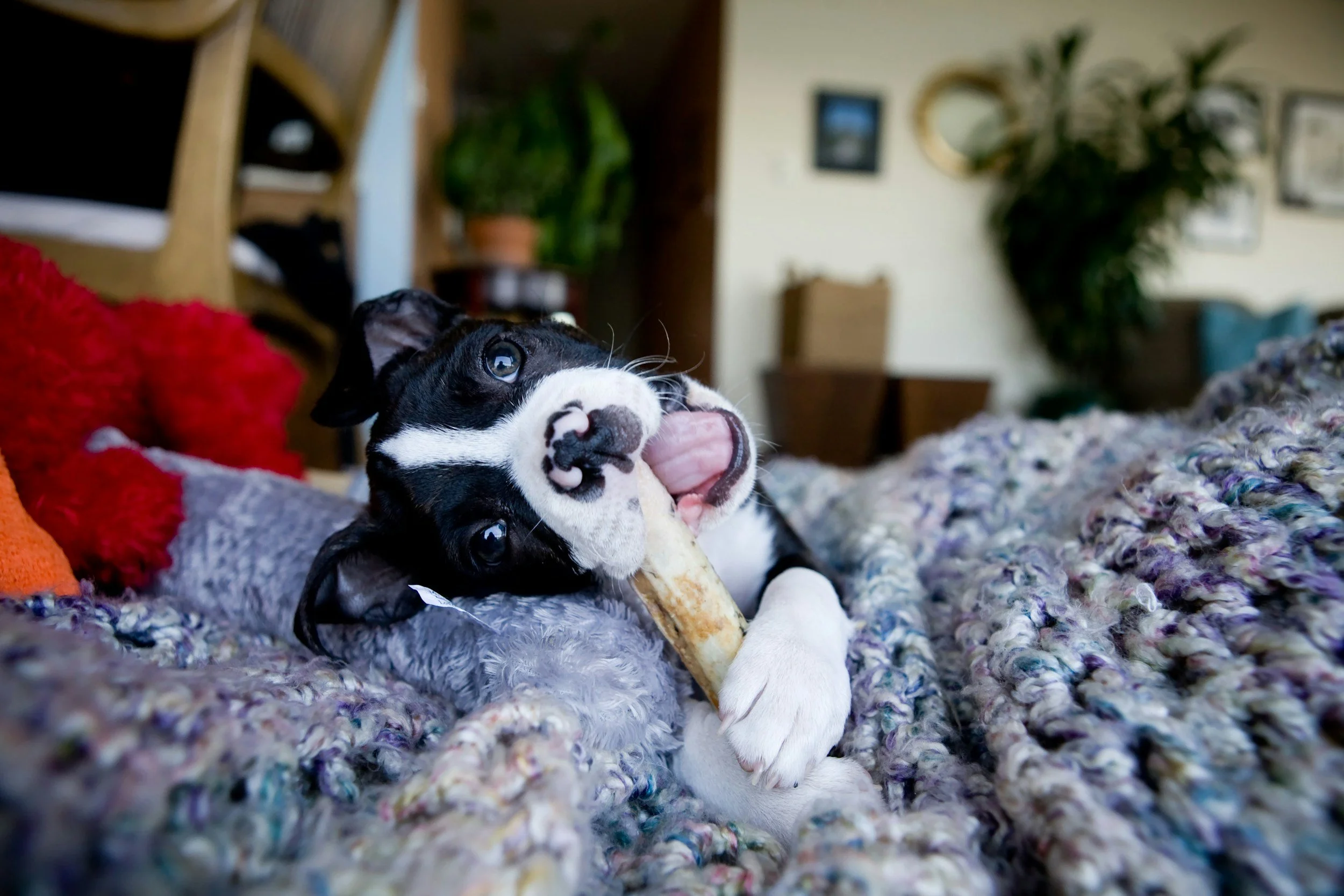
A black and white puppy laying on a blanket is chewing on an edible chew treat.
Why do puppies bite, mouth, and chew?
They’re babies and exploring the world with their mouths. At this age, they’re experimenting with their environment, learning what tastes good, what is safe/unsafe, what feels good to chew on (especially while teething), and generally how to get their needs met.
Sometimes puppies chew on us as a way to communicate a need: they want attention, they need to use the bathroom, they’re hungry, etc. For this reason, I don’t normally ignore chewing!
Puppies can also learn that chewing on hands makes hands go away; this is important to understand because we often like to pet/touch dogs when they’re not necessarily in the mood. By waiting for your puppy to initiate physical contact, making your unsolicited attention/handling into a training exercise, or using the Pet/Pet/Pause method you can avoid putting your puppy into a situation where they use mouthing as a way to make your hands go away.
Puppies don’t bite, mouth, and chew on you or items in their environment as a way to cause you personal discomfort, as revenge, or as a way to purposely inconvenience you. They are simply doing what puppies do at this age!
How do you handle biting, mouthing, and chewing?
Management! Prevent your puppy from having access to items you do not want to chew on. This doesn’t need to be forever but for now, put shoes away, gate off areas with tempting items, and make sure your puppy is not left unsupervised to make choices you don’t like.
Redirection! If your puppy begins to chew on you or something you don’t want them to chew on, gently encourage them to take a toy. Be sure to keep a variety of chewable toys in every area your puppy spends time in. Make the toy you want your puppy to redirect to more enticing than the item they’re currently chewing on by animating it and offering praise when they begin to chew on the desired toy. Be sure to remove access to the item your puppy was chewing on beforehand at that point.
Magic toy! Instead of focusing your energy on noticing when your puppy chews on things you don’t want them to chew on, try to notice moments where your puppy DOES chew on something you like. Anytime they play with a toy, praise them and offer to play with them. Your puppy can quickly pick up on that playing with their toys gets them consistent attention.
No yelping, scolding, or punishing! Yelping when puppies chew on us can reinforce or excite our puppies. Instead, redirect, or remove your body from the situation. Stand on the other side of a baby gate or walk into another room for a moment.
Make sure your puppy is getting enough sleep! Puppies that are overtired tend to be mouthier and harder to redirect. Ensure your puppy is getting structured naps throughout the day (at least one in the a.m. and one in the afternoon).
It’s a phase…for some dogs! :) Although many dogs will outgrow the need to put any and everything in their mouths as they complete the process of adult teeth growing in (around 6-8 months of age), some dogs simply do not outgrow chewing and that’s normal. If you have a dog that really enjoys chewing on items beyond puppyhood and adolescence, be sure to supply them with adequate chewing items life long. Additionally, know that chewing is an incredible outlet for dogs to deal with stress and overstimulation! If your puppy gets really worked up or needs support in calming down, supplying them with a puppy safe edible chew can go a long with helping your dog decompress.
Chews for your Puppy
The general rule of thumb is that a chew toy should be soft enough for your to press your nail into. Be sure to buy toys and chews that are size appropriate for your puppy. There are a wide variety of puppy safe chew toys out there. Below are some of the tried and true edible chews puppies I have cared for enjoyed:
HOW CAN DOG FLOWER HELP?
Puppy socialization and training doesn’t have to be hard, and if you’re finding that you need support, we are here to help. Our puppy socials, group classes, and private training can provide assistance with any and everything puppy socialization and training related. Not sure where to start? Scheduled a FREE 10-minute Discovery Call with Meaghan below.
LEARN MORE ABOUT THE AUTHOR, DOG TRAINER Meaghan SUMMERBELL
Meaghan Summerbell (KPA CTP, CSAP-BC, CTDI) is a multi-certified professional dog trainer serving East Portland, Gresham, Troutdale and Happy Valley, Oregon. Meaghan is dedicated to helping people understand the inner workings of canine behavior on a deeper, more meaningful level so you can become your dog’s best friend, too.
This is an AI free blog post. All blog posts are written and published by Meaghan.
Keywords: puppy mouthing, puppy biting, puppy chewing, how to stop puppy biting, how to stop puppy chewing, Portland puppy training, Gresham puppy training, Happy Valley puppy training, Troutdale puppy training
