
Loose Leash Walking and Anti-Pulling Help For Dogs and Puppies
Have you ever felt like walking your dog was a chore instead of an opportunity to explore and bond with your dog? Maybe your dog is scared of going for a walk, overstimulated and jumping on you when you put on their dog walking gear, or just pulls you every which way once you’re outside. These situations are all common, and can be helped through understanding your dog’s body language, setting up routines, compassion towards yourself and your dog, and basic training.
Why do dogs struggle to walk on a leash?
They’re full of energy
For many dogs living in an urban environment, going for a walk is their primary source of exercise. Many dogs have a need for a completely different type of exercise, more intense exercise opportunities, and less restriction to truly have their needs met. If they’ve been cooped up all day while you’re at home, it’s not abnormal for them to be bursting with energy before and after you get out the door.
They’re scared
Some dogs are simply overwhelmed or fearful out in the world. This is very common with dogs that were not properly socialized as a young puppy and especially dogs that may have experienced traumatic living situations. The outside world can be quite frightening for a dog that simply has never been supported so that they can feel safe with all our neighborhoods present.
They’re overstimulated
As soon as you walk out the door, us and our dogs are exposed to an overwhelming amount of stimuli to process. On top of that, your dog’s nose is incredible and the best part of the walk for most dogs is the opportunity to smell (check their “pee mail”). Often, puppies and adolescent dogs are struggling with their emotional regulation skills on top of this, which means that being simultaneously overstimulated while having little ability to contain all of their “big feelings” can result in what feels like a chaotic experience.
they don’t know another way
The simple fact is that dogs learn quickly that pulling gets them to go where they want to go. Dogs do what works for them. If we want them to do something else, we have to teach them what to do instead. On top of that, if we pull on our dogs because they’re pulling, their opposition reflex is likely to engage, causing them to pull against us. It might feel like a never ending cycle.
Their natural pace is different from yours
Often we see dogs pulling ahead simply because they walk faster than the human that is taking them out. Occasionally, I’ll see a dog that walks slower than their guardians, either due to old age or their interest in exploring their environment. Regardless, our paces are often mismatched. This can be exacerbated by walking multiple dogs at once.
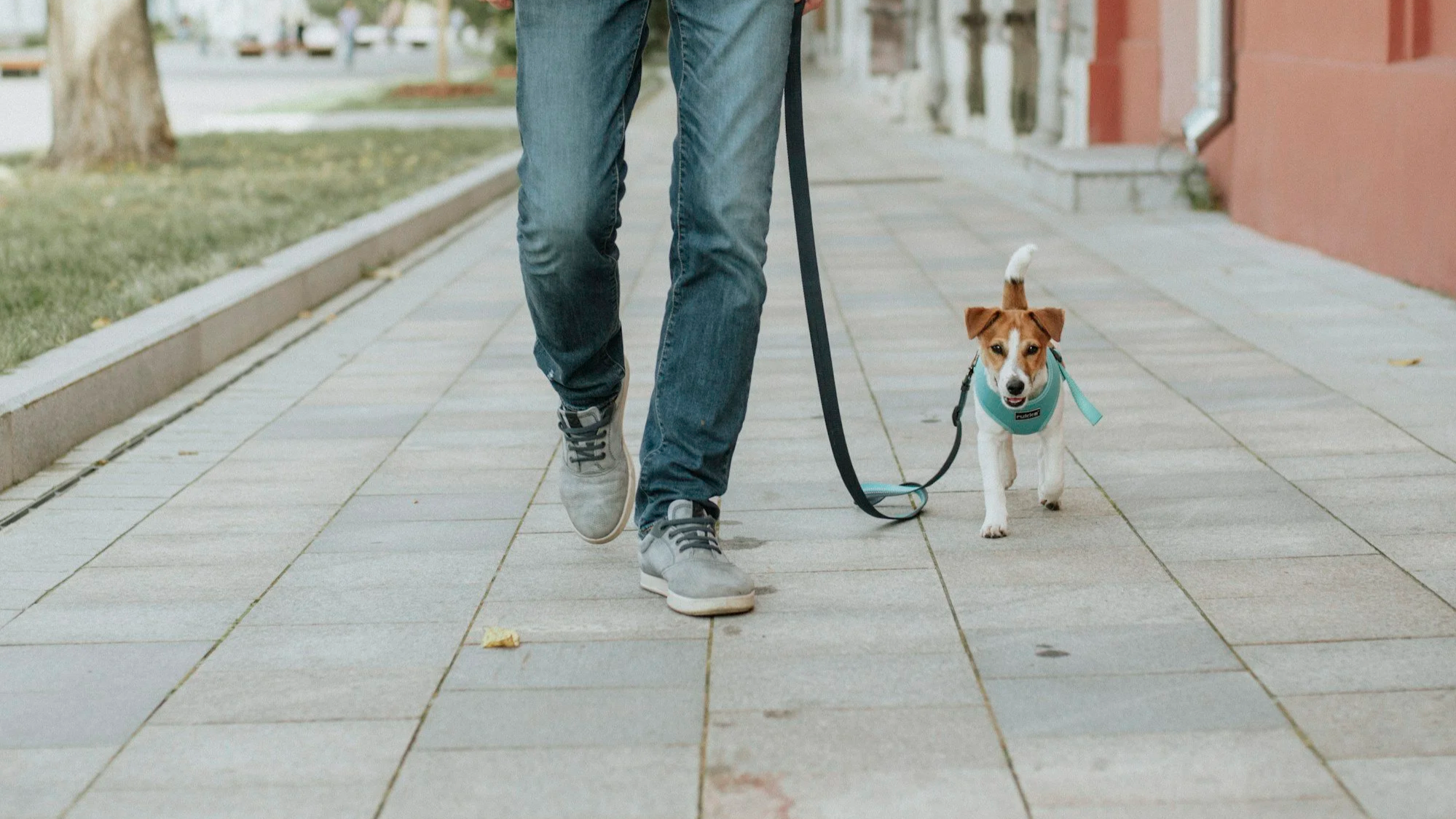
How do you get your dog to walk comfortably on a leash?
Tip #1. Understand dog body language
One of the best things you can do as a dog guardian is spend time learning to understand basic dog body language. While we often learn to understand our dogs over time, there are a myriad of subtle behaviors dogs display that are frequently misunderstood by humans. An example of this is a wagging tail. I often hear people say things like “she was barking and growling at this person, but her tail was wagging so I think she wanted to say hi.” When you’re reading dog body language, it’s important to look at the full picture. I personally love THIS illustrated chart by Lili Chen as well as her book, Doggie Language, as resources for learning how to read your dog’s body language.
Tip #2. Exercise your dog ahead of time
Walking your dog does not have to be your primary source of exercising your dog. Many dogs benefit from a bit of playing with a tug toy or flirt pole indoors prior to going for a walk. Another option would be a game of “find it” where you call your dog over to you, say “find it” then toss a treat for them to run after and chase. After 10-15 repetitions of that, most dogs will have been warmed up enough to go out for a walk with less pent up energy.
Tip #3. Bring a treat pouch and food rewards on walks
There are so many moments during your walk that your dog can be reinforced for. Be sure to invest in a treat pouch so that you don’t have to carry treats in your hands. Ensure you have a variety of treats available to you as well, including high value treats, since walking exposes your dog to a high level of distraction and we typically want to match distraction level to treat level (high distraction = high value rewards).
Tip #4. Walk your dog in a different environment
If you live somewhere that is simply too stressful for your dog or you to walk in, there is no harm or shame in driving your dog elsewhere to walk. Simply giving your dog a change of scenery can provide extra interesting sniffing opportunities as well as relief from the busyness of downtown like areas. If your dog experiences fear or reactivity while walking in your neighborhood, I strongly recommend trying this, as well as making visits to greenspaces with your dog on a long line, a weekly activity. For private greenspaces, check out the Sniff Spot app.
Tip #5. Address your dog’s fear or reactivity
If your dog is scared and/or barking/growling/lunging at people/cars/dogs/ on your walks, then working with an experienced behavior professional and consulting with your veterinarian (to rule out underlying medical conditions) is recommended. In addition, I encourage you to avoid putting your dog in situations that trigger them in the meantime. Consider walking really early in the morning or late at night, Sniff Spots, using a friend’s yard, alternative forms of exercise and/or driving them to a different location to walk.
Tip #6. Focus on enrichment
In my experience, it is all too common to have high expectations for our dogs to adhere to the rules we’ve made up for them while simultaneously depriving them of opportunities to just be a dog. Enrichment is really giving your dog those experiences to express species specific behaviors like foraging, digging, sniffing, chewing, chasing, exploring and playing. I recommend researching your dog’s breed(s) to learn more about their history and what your dog’s ancestors were bred to do. When possible, provide them with similar outlets. If you have a herding dog, give them opportunities to chase, etc. A great book to check out is Canine Enrichment for the Real World by Allie Bender and Emily Strong. Although food toys are a great way to provide your dog with mental enrichment each day, they should not be the only source of enrichment you provide your dog with. When our dog’s core canine needs are regularly met, it will be much easier for them to adhere to the rules of loose leash walking, and many of our other training goals.
Tip #7. Avoid on leash greetings
If your dog is struggling with pulling, one of the last things you want to do is let them (or encourage them) to pull you up to people or dogs. Instead, focus on rewarding your dog for engaging with you (looking at you, performing other behaviors like sniffing for a treat, climbing on obstacles in the neighborhood, sitting by you) and then moving along once the distraction has moved on. Although there are some circumstances where leash greetings are appropriate, I like to practice a “go say hi” skill ahead of time so that I can let my dog know when we are going to greet someone or another dog. Dog to dog leash greetings can be very tricky, and in my opinion, it is rarely worth it to let your dog greet a stranger's dog while on leash in the neighborhood as the restriction the leashes provide can make for an uncomfortable experience for both dogs. Negative on-leash interactions can contribute to leash-reactivity development. On the flip side of that, if your dog learns that pulling and barking gets them to approach another dog or person, it can be quite frustrating when your dog is not allowed to say hello. This in itself can turn into a form of reactivity while on leash.
Tip #8. Train loose leash walking skills where your dog can be successful
If you want your dog to be proficient in loose leash walking, it’s imperative that you practice the components of loose leash walking where your dog can be successful (often inside). Including loose leash walking skills in your regular training routine, as well as warming up indoors before actually going outside, is truly a game changer.
Tip #9. Reinforce unprompted eye contact and walking at your side
Two of the easiest behaviors to reinforce when working on loose leash walking are checking in with you by looking up at your face. When your dog makes eye contact, simply mark with a “yes” and follow up with a treat. Keep an eye on your dog so you can catch all the opportunities for you to reinforce that behavior. Secondly, anytime your dog ends up nice and close to your preferred walking side, mark “yes” and offer a reward nice and close to your body to build value with walking at your side.
Tip #10. Use appropriate dog walking gear
Often I see dogs being walked in gear that is simply uncomfortable for them or their guardians. Aim to purchase a harness such as the Pet Safe 3-in-1 harness or Balance harness by Blue-9. These harnesses allow you to adjust all of the components so that you can get a perfect fit. They also don’t have to go over your dog’s head and they both have a front clip option that can be helpful if you have a powerful dog. Be sure to use a flat (non-rope) leash that fits well in your hand, and isn’t too heavy for your dog. With small dogs especially, try to use something that is a ½” or smaller. The lighter the better. I love biothane leashes due to being odor and water resistant.
HOW CAN DOG FLOWER HELP?
Training your dog to walk politely on a leash doesn’t have to be hard, and if you’re finding that you need support, we are here to help. Our group classes, at-home daytraining and private training can provide assistance with any and everything puppy socialization and training related. We cover the basics of loose leash walking in our Puppy Kindergarten and Basic Manners group classes. We work extensively on leash skills in our Loose Leash Walking & Recall group class. Learn more about our group classes HERE.
Not sure where to start? Scheduled a FREE 10-minute Discovery Call with Meaghan below.
LEARN MORE ABOUT THE AUTHOR, DOG TRAINER Meaghan SUMMERBELL
Meaghan Summerbell (KPA CTP, CSAP-BC, CTDI) is a multi-certified professional dog trainer serving East Portland, Gresham, Troutdale and Happy Valley, Oregon. Meaghan is dedicated to helping people understand the inner workings of canine behavior on a deeper, more meaningful level so you can become your dog’s best friend, too.
This is an AI free blog post. All blog posts are written and published by Meaghan.
Keywords: loose leash walking, dog walking, how to stop my dog from pulling on the leash, portland dog walking, gresham dog walking, happy valley dog walking, troutdale dog walking, why does my dog pull on the leash
